Bourbon State of Mind A Speakeasy · Est. 1922
Back to the House
Chapter I · The Fruit Bowl

Cherry, Pineapple, Citrus

Five drinks built on fresh cherries, pineapple juice, and good bitters. Bright on the nose, warm on the finish.

No. 01

Pineapple Whiskey Smash

Tropical old fashioned · lively

· · ·
  • 2 oz bourbon or rye
  • 2 oz pineapple juice
  • ½ oz fresh lemon juice
  • 2 dashes aromatic bitters
  • 1 fresh cherry, muddled
  • Lemon wheel and cherry to garnish
  1. Muddle the cherry in a shaker.
  2. Add whiskey, pineapple, lemon juice, and bitters.
  3. Shake with ice and strain over fresh ice.
  4. Garnish with a lemon wheel and a cherry.

FlavorBright, lightly sweet, grounded by the bitters so it never drinks like a juice cocktail.

No. 02

Pineapple Cherry Nightcap

Stirred · richer · a slow sipper

· · ·
  • 2 oz bourbon
  • 1½ oz pineapple juice
  • 1 dash cherry bitters
  • 2 dashes aromatic bitters
  • 1 fresh cherry, muddled
  • Cherry to garnish
  1. Muddle the cherry in a mixing glass.
  2. Add bourbon, pineapple, and both bitters.
  3. Stir with ice (do not shake) until very cold.
  4. Strain over one large cube. Garnish with a cherry.

FlavorRound, slightly smoky, meant to be sipped not slung back.

No. 03

Cherry Orange Old Fashioned

Classic structure · deeper fruit

· · ·
  • 2 oz bourbon
  • 1 fresh cherry
  • 1 maraschino cherry
  • 1 orange peel or small fresh orange slice
  • 2 dashes aromatic bitters
  • 1 dash cherry bitters
  1. Muddle both cherries and the orange in a rocks glass.
  2. Add both bitters and the bourbon.
  3. Stir with ice until well chilled.
  4. Express an orange peel over the top and drop it in.

FlavorThe fresh cherry keeps it rich. The maraschino adds the nostalgic sweetness.

No. 04

Rye Cherry Lime Sour

Sharp · citrus driven · the spice shines

· · ·
  • 2 oz rye
  • ¾ oz fresh lime juice
  • ¼ oz fresh lemon juice
  • 1 dash cherry bitters
  • 1 dash aromatic bitters
  • 1 maraschino cherry, lightly muddled
  • Lime wheel to garnish
  1. Muddle the maraschino cherry gently.
  2. Add rye, lime juice, lemon juice, and both bitters.
  3. Shake with ice and strain into a coupe or over fresh ice.
  4. Garnish with a lime wheel.

FlavorTart, slightly dry. Let the rye spice do the talking.

No. 05

Bourbon Citrus Bitters Spritz

Aperitif style · no soda required

· · ·
  • 2 oz bourbon
  • 1 oz fresh orange juice
  • ½ oz fresh lemon juice
  • 2 dashes aromatic bitters
  • 1 dash cherry bitters
  • Orange peel to garnish
  1. Shake everything with ice.
  2. Strain into a large ice-filled glass.
  3. Express an orange peel over the top.

FlavorCitrusy and aromatic with a softer bourbon finish. Drinks like a light aperitif.

Tasting note. · Every one of these is written for two ounces of whiskey and standard ice unless noted. Scale up for a group by the same ratios. Taste as you build and adjust: if a drink feels too sharp, add a tiny bit more syrup. If it feels too sweet, add one more drop of citrus instead of another dash of bitters. That small habit is what separates a home cocktail from a proper one.

Chapter II · Autumn & Cinnamon

Pairings for Granny Smith Pie

Four cocktails built to sit beside a tart apple pie on a cold night. The first three reach for cinnamon and orange. The last two are for when the pie is already on the table.

No. 06

Cinnamon Bourbon Old Fashioned

Warm · spiced · designed for tart pie

· · ·
  • 2 oz bourbon
  • ¼ oz simple syrup (start with less)
  • 2 dashes aromatic bitters
  • 1 dash cherry bitters
  • Tiny pinch ground cinnamon
  • Orange peel or small orange slice
  • Fresh cherry to garnish
  1. Add bourbon, syrup, bitters, and the pinch of cinnamon to a mixing glass with ice.
  2. Stir until well chilled and silky.
  3. Strain over one large cube in a rocks glass.
  4. Express the orange peel over the drink and drop it in.
  5. Garnish with a fresh cherry.

PairingThe cinnamon mirrors the pie spice. The syrup softens the apples. The orange oils smell like warm crust.

No. 07

Bourbon Lemon Cinnamon Sour

A palate reset between bites

· · ·
  • 2 oz bourbon
  • ½ oz fresh lemon juice
  • ¼ oz simple syrup
  • 2 dashes aromatic bitters
  • Pinch of cinnamon
  • Lemon twist (optional)
  1. Shake everything hard with ice.
  2. Strain over fresh ice or serve up.
  3. Express a lemon twist over the top if you like.

PairingCuts through crust and butter. Drinks bright next to a tart Granny Smith pie.

No. 08

Spiced Bourbon Apple Cider

Served warm · cozy · the fall classic

· · ·
  • 2 oz bourbon
  • 4 oz prepared spiced apple cider (hot)
  • ¼ oz simple syrup (optional, taste first)
  • 2 dashes aromatic bitters
  • Tiny pinch cinnamon
  • Orange peel or lemon twist to garnish
  1. Prepare the spiced cider with hot water per package directions.
  2. Pour into a heatproof mug and add bourbon, bitters, and a pinch of cinnamon.
  3. Taste. Only add syrup if it reads too tart.
  4. Garnish with an expressed orange peel or lemon twist.

PairingThe cider echoes the apple filling. The bitters keep it from drinking sugary.

No. 09

Chilled Spiced Cider Bourbon

Crisp · bright · when the pie is still warm

· · ·
  • 2 oz bourbon
  • 3 oz prepared and chilled spiced apple cider
  • ¼ oz fresh lemon juice
  • 1 to 2 dashes aromatic bitters
  • Lemon twist to garnish
  1. Shake all ingredients with ice.
  2. Strain over fresh ice in a rocks glass.
  3. Express a lemon twist over the top.

PairingWorks best when the pie is served warm out of the oven. Add a splash more cider if it feels too sharp.

Chapter III · The Gin Parade

A Shelf of Gin Classics

Nine cocktails from the years when gin was everywhere and mostly terrible. The honey, the herbs, and the citrus were all doing work.

No. 10

Bee's Knees

Gin, honey, lemon · the covering up of sins

· · ·
  • 2 oz gin
  • ¾ oz fresh lemon juice
  • ¾ oz honey syrup (2 parts honey, 1 part warm water)
  • Lemon twist to garnish
  1. Stir the honey and warm water together until the syrup is smooth.
  2. Add gin, lemon juice, and honey syrup to a shaker with ice.
  3. Shake hard, strain into a chilled coupe.
  4. Express a lemon twist over the top and drop it in.

HistoryBorn in the 1920s to hide the taste of bad bathtub gin. The honey covers, the lemon sharpens. Still worth making with good gin because the balance was right all along.

No. 11

French 75

Gin, lemon, champagne · dangerous in the nicest way

· · ·
  • 1 oz gin
  • ½ oz fresh lemon juice
  • ½ oz simple syrup
  • 3 oz cold champagne or dry sparkling wine
  • Long lemon twist to garnish
  1. Shake gin, lemon juice, and syrup with ice until very cold.
  2. Strain into a chilled champagne flute.
  3. Top with cold champagne.
  4. Express and drop in the lemon twist.

HistoryNamed after the 75mm French artillery piece. One bartender described the drink as hitting with all the force of the cannon. It hid rough gin under champagne brilliantly.

No. 12

Aviation

Gin, maraschino, violet · a pale sky in a glass

· · ·
  • 2 oz gin
  • ½ oz maraschino liqueur
  • ¼ oz crème de violette
  • ¾ oz fresh lemon juice
  • 1 maraschino cherry to garnish
  1. Add all ingredients to a shaker with ice.
  2. Shake hard until well chilled.
  3. Double strain into a chilled coupe.
  4. Drop the cherry into the glass.

HistoryA pre-Prohibition recipe from Hugo Ensslin's 1916 bar guide. The violet gives the drink its pale sky tint. When crème de violette disappeared from American shelves for fifty years, the cocktail nearly went with it.

No. 13

Clover Club

Gin, raspberry, egg white · pink and unashamed

· · ·
  • 2 oz gin
  • ½ oz raspberry syrup
  • ½ oz fresh lemon juice
  • 1 fresh egg white
  • 3 fresh raspberries on a pick to garnish
  1. Dry shake all ingredients without ice for fifteen seconds to emulsify the egg white.
  2. Add ice and shake hard again until very cold.
  3. Double strain into a chilled coupe.
  4. Float the raspberry pick across the top.

HistoryNamed for a gentlemen's literary club in Philadelphia that met at the Bellevue-Stratford Hotel before Prohibition. Frothy pink on the outside, dry and gin-forward underneath. Men drank it without apology.

No. 14

Tom Collins

Gin, lemon, soda · long and easy

· · ·
  • 2 oz gin
  • 1 oz fresh lemon juice
  • ½ oz simple syrup
  • 3 to 4 oz chilled soda water
  • Lemon wheel and maraschino cherry to garnish
  1. Shake gin, lemon juice, and syrup with ice until very cold.
  2. Strain into a tall Collins glass filled with fresh ice.
  3. Top with cold soda water.
  4. Garnish with a lemon wheel and a cherry.

HistoryThe drink takes its name from the 1874 "Great Tom Collins Hoax," when New Yorkers sent friends searching bars for a man named Tom Collins who had supposedly insulted them. By Prohibition, every bartender had an answer ready.

No. 15

Southside

Gin, mint, lemon · the 21 Club's house drink

· · ·
  • 2 oz gin
  • ¾ oz fresh lemon juice
  • ¾ oz simple syrup
  • 6 to 8 fresh mint leaves
  • Mint sprig to garnish
  1. Muddle the mint leaves gently in the bottom of a shaker.
  2. Add gin, lemon juice, syrup, and ice.
  3. Shake hard and double strain into a chilled coupe.
  4. Slap a mint sprig between your palms and drop it on top.

HistoryThe Southside was said to be the house drink at the 21 Club in New York. Chicago lore claims the South Side gangs drank it too. Either way, it spread across the country as the bright, cold gin cocktail of the era.

No. 16

Gin Rickey

Gin, lime, soda · the three-ingredient cure

· · ·
  • 2 oz gin
  • ½ oz fresh lime juice
  • 4 oz chilled soda water
  • Spent lime shell to garnish
  1. Fill a highball glass with ice.
  2. Pour the gin and lime juice directly over the ice.
  3. Top with soda water and give one gentle stir.
  4. Drop the spent lime shell into the glass.

HistoryNamed for Colonel Joe Rickey, who drank something similar at Shoomaker's bar in Washington in the 1880s. Dry, uncomplicated, the opposite of ornate. It outlived the fancier drinks by refusing to be dressed up.

No. 17

Corpse Reviver No. 2

Gin, Cointreau, Lillet, absinthe · not for the faint

· · ·
  • ¾ oz gin
  • ¾ oz Cointreau
  • ¾ oz Lillet Blanc
  • ¾ oz fresh lemon juice
  • Absinthe, to rinse the glass
  1. Rinse a chilled coupe with a little absinthe and discard the excess.
  2. Shake gin, Cointreau, Lillet, and lemon juice hard with ice.
  3. Double strain into the absinthe-rinsed coupe.

HistoryFrom Harry Craddock's 1930 Savoy Cocktail Book. Craddock wrote that four in quick succession would "un-revive the corpse again." He was not entirely joking.

No. 18

The Last Word

Gin, Chartreuse, maraschino, lime · equal parts all around

· · ·
  • ¾ oz gin
  • ¾ oz green Chartreuse
  • ¾ oz maraschino liqueur
  • ¾ oz fresh lime juice
  1. Add all four ingredients to a shaker with ice.
  2. Shake hard until well chilled.
  3. Double strain into a chilled coupe.

HistoryInvented around 1916 at the Detroit Athletic Club, then forgotten for half a century. A Seattle bartender revived it in 2004 and it spread from there. Proof that a good recipe will find its way back.
Chapter IV · The Rye Room

Whiskey and Rye Standards

Seven drinks the whiskey cabinet has no business being without. Every one of them survived Prohibition because the math was right.

No. 19

Old Fashioned

Bourbon, sugar, bitters · the original cocktail

· · ·
  • 2 oz bourbon or rye
  • 1 sugar cube (or ¼ oz simple syrup)
  • 2 to 3 dashes Angostura bitters
  • Orange peel to garnish
  • Optional maraschino cherry
  1. Place the sugar cube in a rocks glass and saturate with the bitters.
  2. Add a splash of water and muddle until the sugar is mostly dissolved.
  3. Add one large ice cube and pour the whiskey over.
  4. Stir briefly, then express the orange peel over the top and drop it in.

HistoryWhen "cocktail" came to mean anything elaborate in the late 1800s, drinkers who wanted the old recipe started asking for their whiskey "old fashioned." The name stuck to the drink itself. It is the definition of a cocktail: spirit, sugar, bitters, water.

No. 20

Manhattan

Rye, sweet vermouth, bitters · the New York standard

· · ·
  • 2 oz rye (bourbon also works)
  • 1 oz sweet vermouth
  • 2 dashes Angostura bitters
  • Maraschino cherry to garnish
  1. Add rye, vermouth, and bitters to a mixing glass with ice.
  2. Stir thirty seconds until very cold.
  3. Strain into a chilled coupe.
  4. Drop in a cherry and serve.

HistoryFirst served at the Manhattan Club in New York in the 1870s. It held up through Prohibition because the vermouth and bitters masked the harshness of bad whiskey. Rye is the classical spec. Bourbon is the softer modern choice.

No. 21

Sazerac

Rye, Peychaud's, absinthe · a New Orleans prayer

· · ·
  • 2 oz rye (or cognac for a classical build)
  • ¼ oz simple syrup
  • 3 dashes Peychaud's bitters
  • Absinthe, to rinse the glass
  • Lemon peel
  1. Rinse a chilled rocks glass with absinthe and discard the excess.
  2. Stir rye, syrup, and bitters in a mixing glass with ice until cold.
  3. Strain into the prepared glass without ice.
  4. Express the lemon peel over the top. Traditionally, the peel is discarded, not dropped in.

HistoryThe unofficial drink of New Orleans. Originally built on cognac, which gave way to American rye after French vineyards were wiped out by phylloxera in the 1870s. Named for the Sazerac Coffee House, where it was first served.

No. 22

Whiskey Sour

Bourbon, lemon, sugar · simple, balanced, unkillable

· · ·
  • 2 oz bourbon or rye
  • ¾ oz fresh lemon juice
  • ¾ oz simple syrup
  • ½ oz egg white (optional, for the foam)
  • Dash of Angostura bitters on the foam
  1. If using egg white, dry shake all ingredients without ice for fifteen seconds.
  2. Add ice and shake hard until very cold.
  3. Double strain into a chilled coupe, or over one large cube.
  4. Dash Angostura bitters across the top of the foam.

HistoryPrinted in Jerry Thomas's 1862 bartender's guide, long before Prohibition. The Sour is the middle ground between a toddy and a punch. Egg white makes it a Boston Sour. Without the lemon, you have a Toddy. With soda, a Fizz.

No. 23

The Scofflaw

Rye, vermouth, grenadine, lemon · named for those who ignored the law

· · ·
  • 2 oz rye
  • 1 oz dry vermouth
  • ½ oz fresh lemon juice
  • ½ oz grenadine
  • 2 dashes orange bitters
  • Lemon peel to garnish
  1. Add all ingredients to a shaker with ice.
  2. Shake hard until well chilled.
  3. Strain into a chilled coupe.
  4. Express the lemon peel over the top.

HistoryInvented in 1924 at Harry's New York Bar in Paris, the same week Americans coined "scofflaw" for people who openly flouted Prohibition. The Parisian bartenders celebrated by naming a drink in their honor.

No. 24

Boulevardier

Bourbon, Campari, sweet vermouth · the winter Negroni

· · ·
  • 1½ oz bourbon
  • 1 oz Campari
  • 1 oz sweet vermouth
  • Orange peel to garnish
  1. Add all ingredients to a mixing glass with ice.
  2. Stir until very cold.
  3. Strain over one large cube in a rocks glass, or into a chilled coupe.
  4. Express the orange peel over the top and drop it in.

HistoryCreated by Erskine Gwynne, an American expat in 1920s Paris who ran a literary magazine called The Boulevardier. A Negroni with bourbon in place of gin. Richer, slower, and made for colder rooms.

No. 25

Blood and Sand

Scotch, cherry, orange · named for a Valentino picture

· · ·
  • ¾ oz blended Scotch
  • ¾ oz cherry liqueur (Heering is traditional)
  • ¾ oz sweet vermouth
  • ¾ oz fresh orange juice
  • Orange peel to garnish
  1. Add all ingredients to a shaker with ice.
  2. Shake hard until well chilled.
  3. Strain into a chilled coupe.
  4. Express the orange peel over the top.

HistoryNamed for the 1922 Rudolph Valentino film about a bullfighter. One of the few era classics built on Scotch rather than American whiskey, which made it popular with American drinkers traveling abroad to drink legally.

Chapter V · The Continental

Brandy, Rum, and Apple

Four drinks that traveled well. Each one has a port of origin, and each one crossed the Atlantic at least once before settling into its final form.

No. 26

Sidecar

Cognac, Cointreau, lemon · brandy refined

· · ·
  • 2 oz cognac
  • ¾ oz Cointreau
  • ¾ oz fresh lemon juice
  • Sugar for the rim (optional)
  • Lemon peel to garnish
  1. If using a sugar rim, moisten the coupe edge with lemon and press into sugar.
  2. Add cognac, Cointreau, and lemon juice to a shaker with ice.
  3. Shake hard until well chilled.
  4. Double strain into the prepared coupe and express a lemon peel over the top.

HistoryHarry's New York Bar in Paris and the Ritz in London have both claimed it. Both stories say the drink was invented for an army captain who arrived at the bar in a motorcycle sidecar during the First World War.

No. 27

Mary Pickford

Rum, pineapple, grenadine · Havana during Prohibition

· · ·
  • 2 oz white rum
  • 1½ oz fresh pineapple juice
  • ½ oz grenadine
  • 1 dash maraschino liqueur
  • Maraschino cherry to garnish
  1. Add all ingredients to a shaker with ice.
  2. Shake hard until very cold.
  3. Double strain into a chilled coupe.
  4. Drop in the cherry.

HistoryBorn at the Hotel Nacional de Cuba during Prohibition, when American film stars traveled to Havana to drink legally. Named for Mary Pickford, "America's Sweetheart," who visited more than once and reportedly approved.

No. 28

Jack Rose

Applejack, grenadine, lemon · straight from New Jersey

· · ·
  • 2 oz applejack
  • ½ oz fresh lemon juice
  • ½ oz grenadine
  • Lemon twist to garnish
  1. Add applejack, lemon juice, and grenadine to a shaker with ice.
  2. Shake hard until well chilled.
  3. Strain into a chilled coupe.
  4. Express the lemon twist over the top.

HistoryNamed for New Jersey applejack, the only American spirit that rivaled moonshine in the mountains for regional identity. Hemingway's narrator in The Sun Also Rises orders one while waiting. It was the right drink for waiting.

No. 29

Between the Sheets

Cognac, rum, Cointreau, lemon · for patrons with all night

· · ·
  • ¾ oz cognac
  • ¾ oz white rum
  • ¾ oz Cointreau
  • ¾ oz fresh lemon juice
  • Lemon peel to garnish
  1. Add all ingredients to a shaker with ice.
  2. Shake hard until well chilled.
  3. Double strain into a chilled coupe.
  4. Express the lemon peel over the top.

HistoryAnother Harry's New York Bar invention from 1920s Paris. Essentially a Sidecar with the addition of rum, designed for patrons who had all night and no compelling reason to go home.

A closing note. · These are the recipes that live on the wall. The other two hundred and ninety-one are in the book, tucked between the tabs, in Cora's hand.

The Rest of the Book

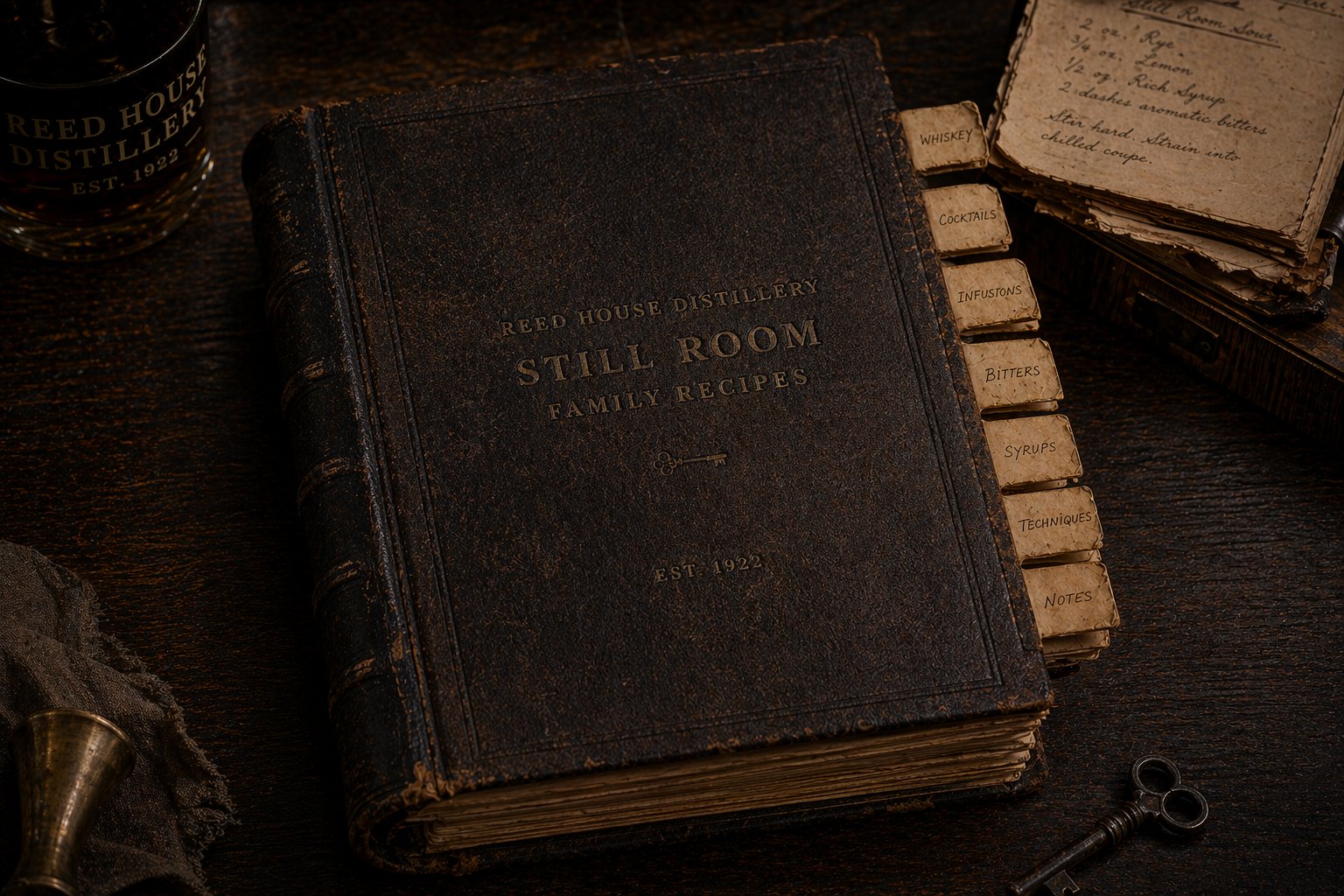
The Still Room Book

Three hundred recipes total. Seven hand-labeled tabs. Whiskey, cocktails, infusions, bitters, syrups, techniques, and a back section of notes. Three editions, including a hand-bound leather run limited to one hundred.

The Still Room Book - Reed House Distillery
See the Book